
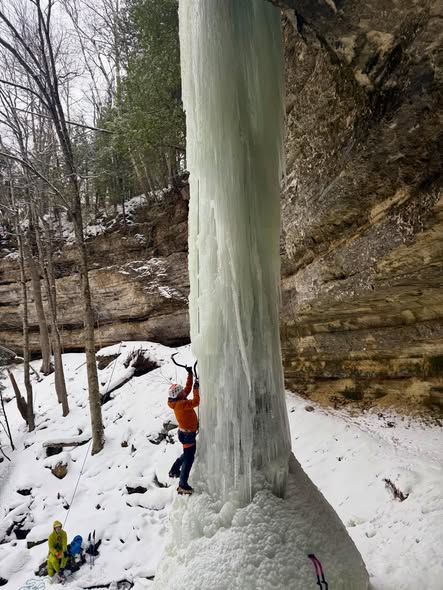
This weekend the Upper Peninsula experienced some brutally cold temperatures- minus 24 degrees with a windchill of -44 in some areas! These temperatures certainly cause issues with climbers but did you know they also cause probles for the pillars that Pictured Rocks is known for? Through the Petzl Foundation and in collaboration with the Institute of Environmental Geosciences (IGE) in Grenoble, conducted in-depth studies on waterfall ice stability, including how cold temperatures affect ice structure. This research, which took place from 2006 to 2010, aimed to understand the behavior of waterfall ice and its safety for climbers. Read the interesting finding below!
From our friends at Petzl–
How does ice react to different weather conditions? Intuitively we might think that very low temperatures are favorable for creating good waterfall ice conditions. Is it this simple? How do we make the connection between climbers’ observations and a scientific experiment? A study led by the Laboratoire de Glaciologie et Géophysique de l’Environnement de Grenoble, supported by the Petzl Foundation, is providing part of the answer.
Ice falls that form gradually can suddenly collapse, especially when vertical. Variations in temperature cause significant mechanical stresses in the ice that may in certain cases be big enough to cause a sudden break in the ice. In fact, the ice expands when heated and contracts when cooled. If cooling is slow, the ice can adapt to the stresses and deform “plastically”; this is referred to as ductile behavior. Conversely, if cooling is quick, the stresses can create cracks or expand those created by an ice axe. The ice therefore has a fragile character. Measurements by pressure sensors installed in the waterfall ice were used to find the link between drastic variations in temperature and a strong increase in mechanical stresses. By considering this last phenomenon, the ice climber holds the key to interpreting ice quality depending on temperature readings during the days preceding a waterfall ice ascent.
Drastic cooling followed by a period of intense cold like we are experiencing right now leads to strong thermal contractions in the ice; the ice becomes fragile. The ice axe strikes contribute to the spread of cracks, with the possibility of a collapse created by the climber himself. Further, during contraction, a free-standing column will shorten, creating strong vertical mechanical stresses in the structure. There is therefore a high risk of sudden collapse of the structure.
Key Safety Principles from our friend Will Gadd:
- Ice Quality Inspection: Before climbing, test for hollow sounds, wetness, or fracturing, which indicate poor stability.
- Safe Positioning: Belayers must be anchored away from potential ice fall, as “ice tends to fly ‘out’ more than sideways”. If a pitch cannot be safely led, it is avoided.
- Technique for Stability: Utilize vertical, staggered tool placements to prevent “barn-dooring” (swinging off balance). Ensure crampon points are fully engaged for maximum stability.
- Risk Management: Do not fall on ice; treat all ice as potentially unstable. If a structure seems unsafe, it likely is.
- Ice Pillar Behavior: Be aware that large pillars or chandeliers can collapse, requiring specific, cautious movement.
Bottom line- please stay safe out there and use good judgement before attempting the pillars at Pictured Rocks National Lakeshore